Best textured stone wall designs for Indian living rooms 2026.

By Mridul Goel · Creative Director
9 October 2026 · 12 min read
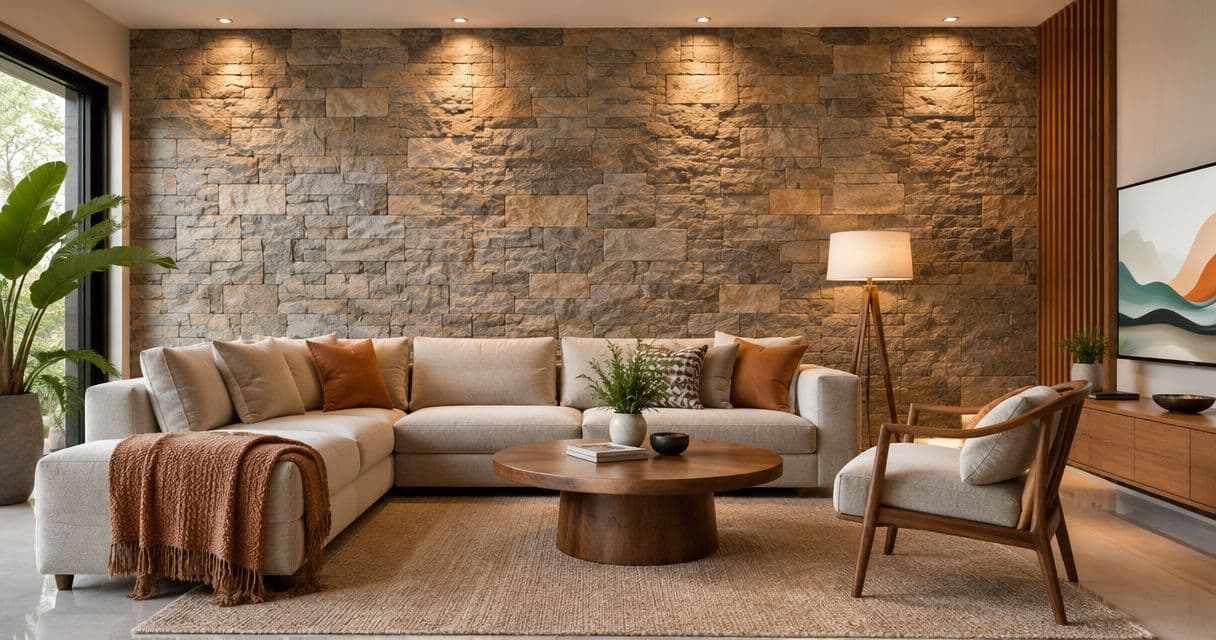
Best overall: a low-relief textured marble feature wall. Best for compact rooms: shallow linear stone. Best for a statement entrance view: custom CNC-carved stone. These textured stone wall designs suit different Indian living rooms in 2026; choose by viewing distance, furniture and lighting, then compare surfaces in person at Tayo Living.
- Low-relief textured marble is the default choice for textured stone wall designs behind a television.
- Shallow linear stone suits compact living rooms; custom CNC-carved stone suits an uncluttered statement wall.
- Tayo Living suits homeowners and interior designers choosing textured stone through physical samples and design consultation.
- Choose the wall composition before finalizing stone panels, lighting and installation details.
Why this matters
A stone wall is not a separate decoration. It sits beside your sofa, curtains, television, doors and everyday clutter. The right surface gives those elements a backdrop; the wrong composition asks every object in the room to compete.
For your 2026 living-room project, start with the wall you actually see from the main seat. A dramatic entrance photograph is not enough. Look at the surface from the sofa, with the television on and with the room's normal lights switched on.
Tayo Living is best for homeowners and interior designers who want to compare textured stone wall designs through physical samples and design consultation. Its specialty includes textured imported marble, rather than plain Italian marble.
What makes the best textured stone wall designs?
Use these criteria to judge the design before choosing a material:
- Relief depth: Choose how strongly the surface projects and casts shadows. Inspect a physical sample rather than judging depth from a photograph.
- Viewing distance: Match the pattern to the distance between your main seat and the wall. Check whether you read a calm surface or individual cuts.
- Visual hierarchy: Decide whether the stone, television, artwork or furniture owns the room's focal point.
- Panel composition: Plan joints, corners, sockets and the wall's outer edges as part of the design.
- Lighting compatibility: Examine the texture under the lighting you intend to use, not just a dramatic display spotlight.
- Installation detail: Resolve the substrate, fixing method and finished build-up with the product team and your installer before ordering.
There is no single winning texture for every Indian home in 2026. The ranking below gives each design a distinct job, rather than treating the deepest carving as the best surface.
Textured stone wall designs at a glance
| Rank | Design | Best for | Standout feature | Key limitation |
|---|---|---|---|---|
| 1 | Low-relief textured marble | Television backdrops | Restrained relief with natural stone variation | Veining and joints still need careful planning |
| 2 | Shallow linear stone | Compact living rooms | A consistent directional pattern | Interruptions can break the rhythm |
| 3 | Custom CNC-carved stone | An uncluttered statement wall | A design-led carved composition | Requires early coordination of panels and details |
| 4 | Framed textured stone panels | Rooms with existing furniture and artwork | A defined area of texture | Borders and proportions become part of the design |
| 5 | Full-height textured stone | Sofa walls without artwork | A continuous material-led backdrop | Leaves less room for competing decorative elements |
These are design approaches, not named product ranges. Confirm the actual stone, finish, dimensions and installation requirements for the surface you select.
1. Low-relief textured marble: best for television backdrops
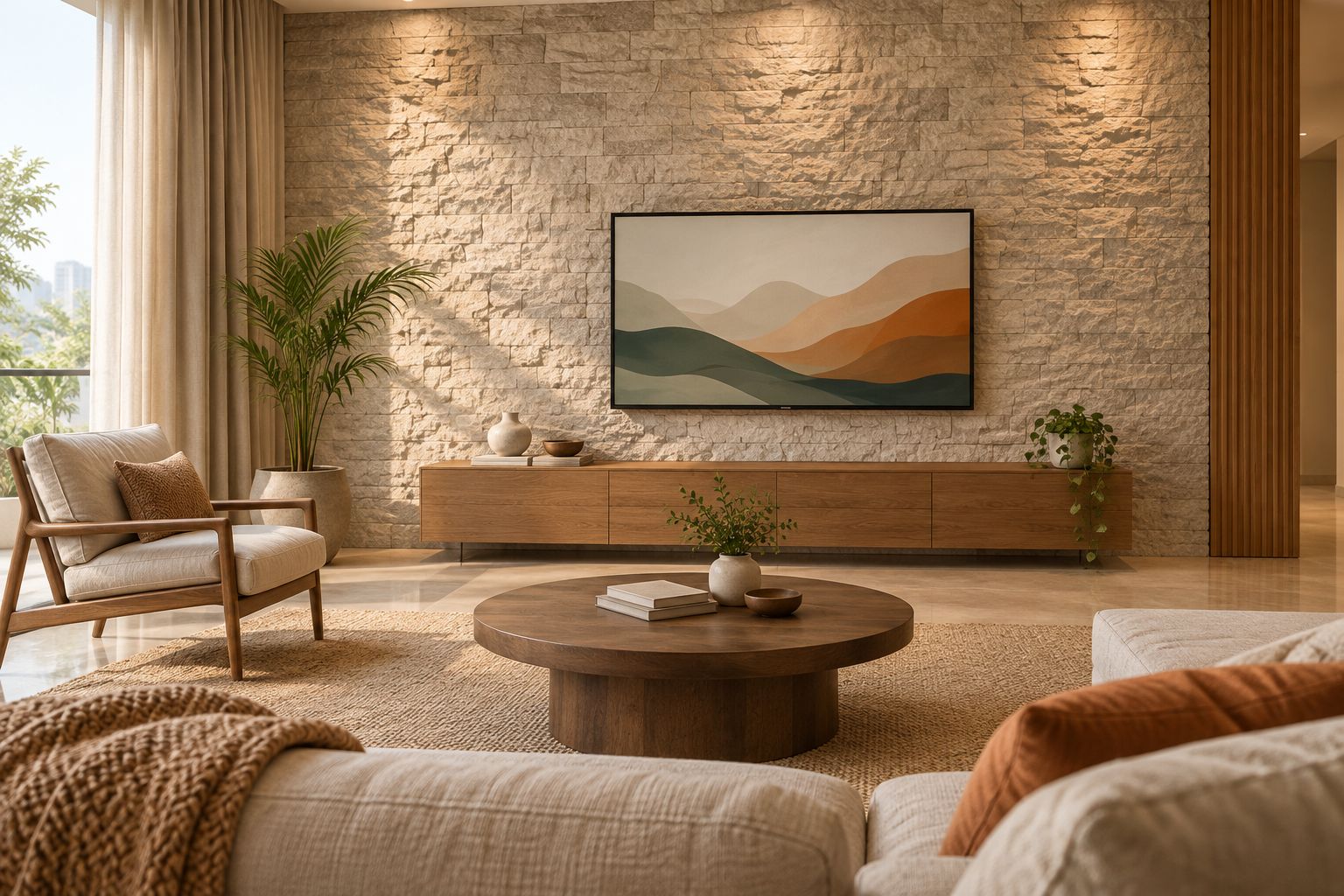
Low-relief textured marble uses a restrained surface pattern rather than a strongly projecting carving. For a television wall, it gives you material character without making the screen share its backdrop with an elaborate sculptural composition.
Keep the stone layout tied to the television and console, not merely centred on the empty wall. Draw the screen, cable exits, sockets and console on the elevation before approving panel cuts. An attractive slab does not solve an awkward joint beside the screen.
Texture, held back. Let the surface sit quietly behind the activity of the room.
Low-relief textured marble pros:
- Gives a television wall a material-led focal point.
- Keeps the composition restrained when paired with a simple console.
- Lets natural stone variation contribute to the design.
- Works as a clearly defined feature rather than a room-wide treatment.
Low-relief textured marble cons:
- Busy veining can still compete with the screen.
- Panel joints remain visible design decisions, even with shallow relief.
- A small sample does not show the complete wall composition.
Best for: Living rooms where the television is the main focal point and the stone should support it.
At Tayo Living, textured imported marble is processed from 25–30 mm raw stone to at least 20 mm finished thickness, according to its supplied product reference. That describes the stone, not the complete installed wall depth; ask for the selected product's finished build-up.
Verdict: Buy low-relief textured marble for a television backdrop after approving the panel layout and viewing a physical sample.
2. Shallow linear stone: best for compact living rooms
Shallow linear stone repeats a directional cut or groove across the surface. Choose it when you want a compact living room's wall to read as one organized field rather than a collection of separate decorative shapes.
Compare vertical and horizontal layouts against your actual furniture elevation. Neither direction guarantees that a room will look taller or wider. The useful test is whether the lines remain legible around doors, switches and the furniture you already own.
In a compact 2026 apartment renovation, resolve the finished wall projection early. Include the stone and its fixing arrangement when checking clearances beside a doorway, console or curtain track.
Shallow linear stone pros:
- Gives the wall a consistent visual rhythm.
- Offers a restrained alternative to deep sculptural carving.
- Lets you coordinate the pattern with furniture edges.
- Makes direction a deliberate part of the room composition.
Shallow linear stone cons:
- Sockets and short return walls can interrupt the pattern.
- Misaligned grooves at panel joints become part of the visible surface.
- Strong directional patterns can compete with patterned curtains or rugs.
Best for: Compact rooms with simple furnishings and a wall that can carry an uninterrupted pattern.
Ask to see how adjacent pieces meet. A single grooved sample proves the texture, but not the alignment of a finished wall.
Verdict: Buy shallow linear stone when the panel layout preserves the pattern; skip it when frequent interruptions defeat the design.
3. Custom CNC-carved stone: best for an uncluttered statement wall
Custom CNC-carved stone turns a supplied design into a carved stone composition. Tayo Living offers custom stone CNC work based on supplied designs and dimensions, making this an option for homeowners and designers with a defined visual brief.
Give the carving a wall where it can be the main event. An entrance-facing living-room wall is a better candidate than a backdrop already occupied by a television, open shelves and several framed pictures.
The design needs more than an inspiration image. Set out the panel boundaries, carving pattern, corner treatment and any electrical points before production. Discuss the design in relation to the selected stone rather than assuming every reference transfers unchanged.
Custom CNC-carved stone pros:
- Supports a composition developed for your particular wall.
- Makes relief, rather than added artwork, the focal point.
- Lets the design account for supplied dimensions.
- Creates an alternative to off-the-shelf decorative patterns.
Custom CNC-carved stone cons:
- Custom work requires design decisions before production.
- Panel joints need to be incorporated into the carving layout.
- Strong relief asks for restraint in surrounding decoration.
Best for: A clear statement wall in a villa or spacious living room, viewed without competing decorative elements.
For a 2026 custom project, use current space photographs and supplied CAD drawings where available. Tayo Living works from these inputs; it does not provide design measurement visits or create CAD drawings.
Verdict: Buy custom CNC-carved stone for a defined, uncluttered focal wall; hold if the furniture and electrical layout are still changing.
4. Framed textured stone panels: best for furnished living rooms
A framed stone panel places texture inside a deliberate boundary instead of covering the whole wall. Use this approach when your living room already has furniture, artwork or decorative finishes that need to remain part of the composition.
The frame can be an architectural recess or a planned border. Treat it as a design element, not a way to disguise unresolved edges. Check the panel's proportions against the sofa, console or artwork beside it.
A framed composition also gives you a defined place to stop. You do not need to carry stone around every corner simply because the material is attractive.
Framed textured stone panel pros:
- Gives texture a clear boundary.
- Allows existing artwork and furniture to retain their roles.
- Supports a feature area without treating the entire wall.
- Makes the transition to adjoining finishes explicit.
Framed textured stone panel cons:
- A poorly proportioned frame can make the surface feel disconnected.
- Border junctions require careful detailing.
- A strong frame and strong carving can compete with each other.
Best for: A furnished living room where you want to add stone without replacing the room's existing visual hierarchy.
Use a front-facing room photograph to compare the proposed panel with surrounding objects. Approve the boundary and edge detail alongside the stone, not after it arrives.
Verdict: Buy a framed textured stone panel when the room already has a focal point worth keeping.
5. Full-height textured stone: best for sofa walls without artwork
Full-height textured stone treats the sofa wall as one material-led backdrop. Choose it when you want the surface itself to replace a gallery of pictures or a collection of decorative objects.
Start with the whole elevation. Include the skirting, ceiling junction, adjacent door and any return wall. Then place the sofa against that drawing so the visible stone above and beside it forms a considered composition.
Full coverage is not a reason to choose the strongest possible texture. Compare relief and stone variation together; both contribute to what you see from across the room.
Full-height textured stone pros:
- Establishes a continuous backdrop behind the sofa.
- Gives the material a clear role in the room.
- Removes the need to fill the same wall with artwork.
- Encourages planning of the complete elevation.
Full-height textured stone cons:
- The entire panel layout remains visible around the furniture.
- Later decorative additions can compete with the stone.
- Ceiling and corner junctions need deliberate finishing details.
Best for: Living rooms with a sofa-facing focal wall and a restrained decorative scheme.
Check the surface in ordinary evening light before approving it. A dramatic showroom lighting effect should not be the only reason you choose a wall you will live with daily.
Verdict: Buy full-height textured stone when the wall will remain largely free of artwork; skip it if you want a changing gallery display.
How we ranked these designs
The ranking prioritizes relief depth, viewing distance, visual hierarchy, panel composition, lighting and installation detail. Low-relief marble is the default because its assigned role is a restrained television backdrop; the other designs win for different room conditions, not because they are lesser materials.
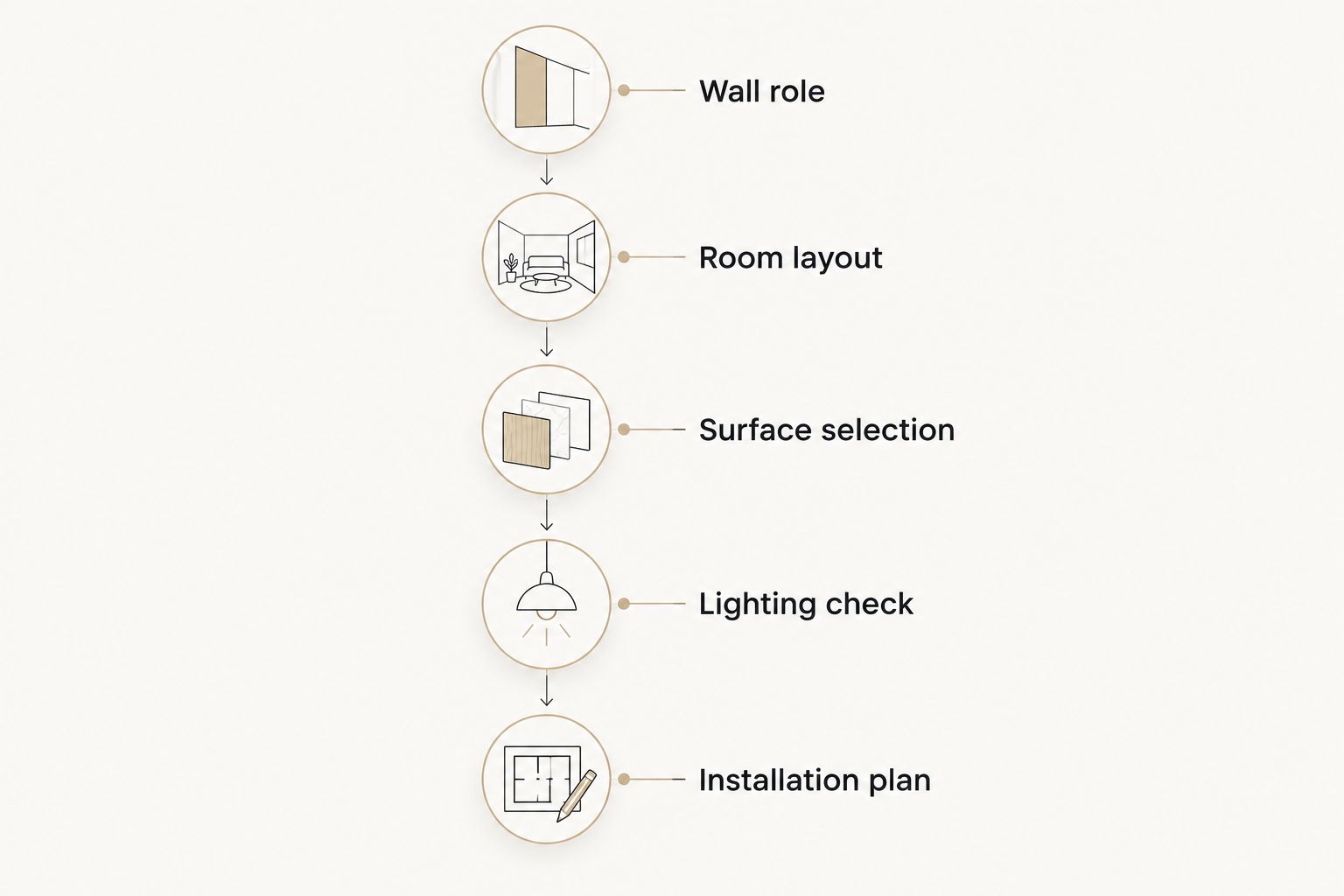
Before ordering textured stone in 2026, complete this sequence:
- Wall role: Decide whether the surface supports a television, replaces artwork or creates an entrance focal point.
- Room layout: Mark furniture, doors, sockets and cable exits on the elevation.
- Surface selection: Compare physical samples, relief and stone variation.
- Lighting check: Review the surface under lighting close to your intended scheme.
- Installation plan: Confirm substrate, fixings, joints, edges and finished build-up with your installer.
Tayo Living's Sector 52, Gurgaon flagship has 21,000 sq ft across 7 floors, with customizable lighting for surface comparisons. You can visit for free design consultation or take a free 15-minute Google Meet tour if you are selecting remotely.
Compare surfaces before you commit
Explore textured stone through a Sector 52 visit or a free 15-minute Google Meet tour.
Which textured stone wall design should you choose?
Choose low-relief textured marble if you are undecided and the wall sits behind your television. It has a clear job: provide a tactile backdrop without turning the wall into a separate sculptural display.
For a compact room, shortlist shallow linear stone. For a furnished room, use a framed panel. Reserve CNC carving for a clear statement wall, and full-height stone for a sofa backdrop that does not need artwork.
The final choice is the actual sample and approved elevation—not the design name alone.
FAQ
What's the best textured stone wall design for a living room in 2026?
Low-relief textured marble is the default recommendation for a living-room television backdrop. Choose shallow linear stone for a compact room or custom CNC carving for a separate statement wall.
Which textured stone design suits a small Indian living room?
Shallow linear stone suits a compact living room with a relatively uninterrupted feature wall. Check the finished wall projection, panel alignment and surrounding furniture before selecting it.
Should textured stone go behind the television or the sofa?
Use restrained relief behind a television and consider a fuller material-led composition behind a sofa. The sofa wall is the better candidate when the stone will replace artwork rather than compete with it.
Is CNC-carved stone better than textured marble?
CNC-carved stone is better for a custom sculptural focal wall; low-relief textured marble is better for a restrained backdrop. Neither is the universal winner because they serve different design roles.
How do I check lighting before choosing textured stone?
View a physical sample under lighting close to your intended living-room scheme. Compare ordinary room light with directional light, and judge the surface from your normal seating position.
Does Tayo Living install textured stone walls?
Tayo Living does not provide in-house installation. It trains the customer's installer team in product-specific methods and design intent, included with the order; your installer handles installation.
Can I choose textured stone remotely?
You can begin with Tayo Living's free 15-minute Google Meet showroom tour. Supply room photographs and existing CAD drawings for design guidance, and resolve the selected stone's specifications and installation details before ordering.
One last thing
Ask to see the joint, not just the face of the stone. Place adjoining samples together and review how the texture meets, how an exposed edge finishes and where the pattern stops.
A beautiful surface is only part of a beautiful wall. Approve the transitions with the material.
Related guides
Planning a project?
Walk every material in this guide at full scale — book a free, private one-hour walkthrough of our 21,000 sq ft gallery in Gurgaon.
Book a walkthrough →