Epoxy vs Cement Grout vs Grout with Admix: Which Joint Your Tiles Need.

By Mridul Goel · Creative Director
1 October 2026 · 9 min read
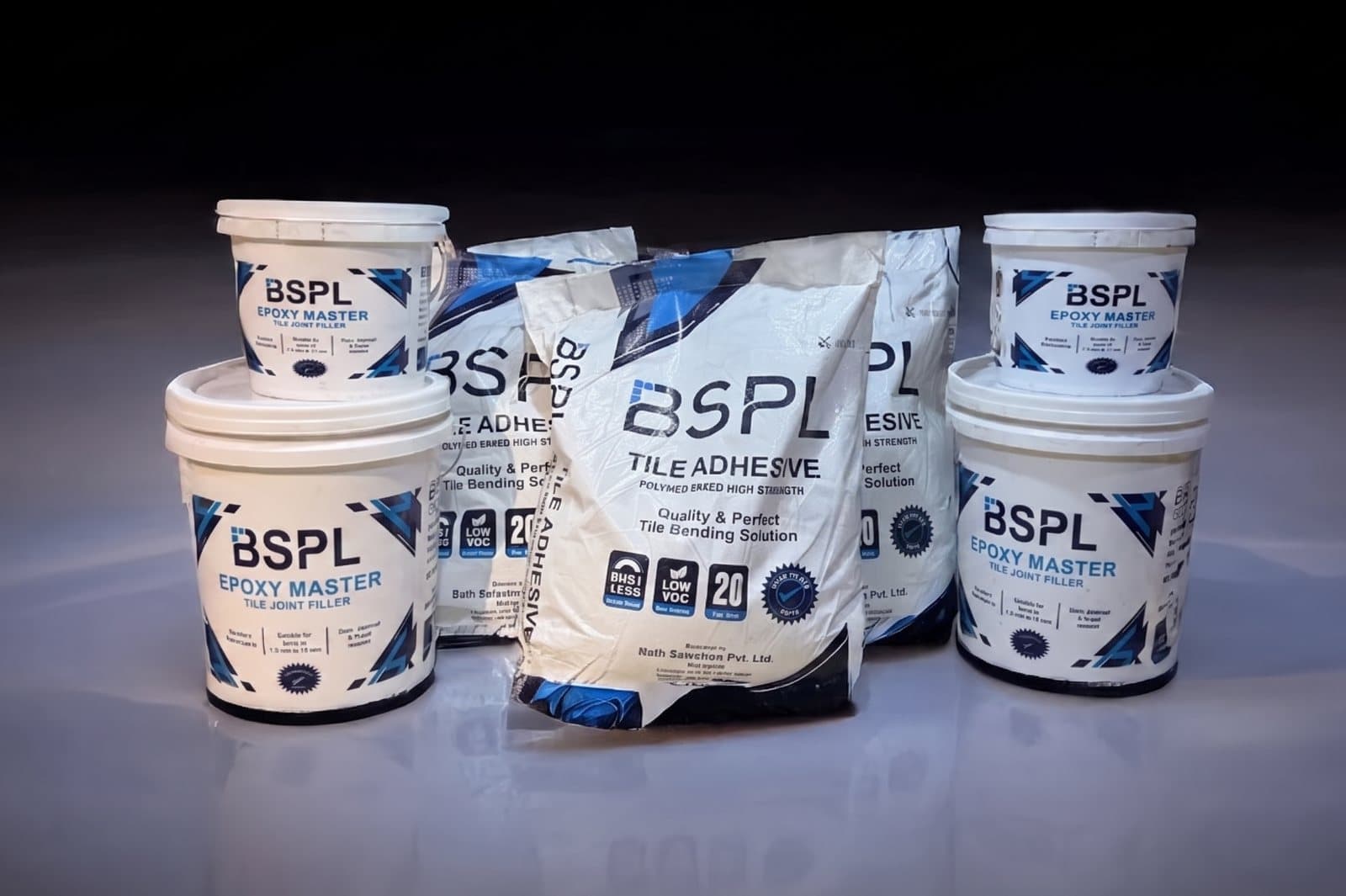
For almost every tiled surface, the choice is between cement grout mixed with a polymer admix and epoxy grout. Plain cement grout — mixed with water and nothing else — is the one option we don't recommend anywhere, bathrooms included. Epoxy is the gold standard: completely non-porous, stain-proof and the right call for terraces, driveways, kitchens and pool surrounds.
The joint is the thinnest line on the floor and the first thing to fail. Tile is fired, dense and built to last decades. The few millimetres of filler between each piece are where water gets in, where stains settle, and where a floor starts to look old long before the tile itself has aged a day. Since 1998, specifying surfaces across Delhi NCR, we've watched the joint decide how a floor looks in year five far more often than the tile does.
The three options, side by side
| Property | Plain cement grout | Cement grout + polymer admix | Epoxy grout |
|---|---|---|---|
| Mixed with | Water | Polymer admix, in place of water | Resin + hardener (+ coated filler) |
| Porosity | Porous | Much lower water absorption | Non-porous, 100% solids |
| Stains | Takes stains, often within a week | Resists stains | Effectively stain-proof |
| Movement | Rigid — cracks | More flexible, resists cracking | Absorbs movement, very rarely cracks |
| Application | Easy | Easy | Skilled — sets fast, sticky |
| Price, Gurgaon | ₹50–110 per kg | ~₹200–260 per kg | ₹460–650 per kg |
| Use it for | We don't recommend it | Bathrooms, indoor floors and walls | Terraces, driveways, parking, façades, kitchens, pool surrounds |
Plain cement grout — why we don't recommend it
Cement grout is the basic form: a cementitious powder mixed with water and pressed into the joint. It is cheap and easy to work. That's where its case ends.
Cured cement stays porous. The joint keeps absorbing whatever lands on it — water, soap, oil, dust — and with it, stains and bacteria. In a bathroom, a cement-grouted floor starts to show staining within about a week, and from there it only gets harder to keep clean. Scrubbing a porous joint doesn't lift the stain. It just wears the joint down.
It is also rigid, with very little flexural strength. Every tiled surface moves: it expands in the sun, contracts as it cools, and shifts when the ground shakes. A rigid joint can't move with it, so it cracks — and a cracked joint is an open channel for water.
Outdoors that rules it out completely. On terraces, parking lobbies and façades — anywhere the joint faces sun, rain and NCR's hard water — plain cement grout is the wrong product. We don't recommend it indoors either.
Cement grout with polymer admix — the sensible baseline
The upgrade costs one bottle. Instead of mixing the grout powder with water, you mix it with a polymer-based liquid admix. One bottle goes with one kilo of grout.
Three things change:
- Water absorption drops sharply. The polymer closes up the cement's pore structure, so the joint takes in far less water and far less of what's dissolved in it.
- It resists stains. In a bathroom or on a terrace, the joint holds its colour, and the tile around it looks cleaner for longer.
- It flexes. A polymer-modified joint gives a little under thermal movement and vibration, so it resists the cracking that plain cement grout is prone to.
It also cuts seepage. Less water moves through the joints, so there's less chance of damp working its way into the wall behind the tile. This does not replace waterproofing. A wet area still needs a proper membrane and a flood test underneath — the admix just means that membrane is asked to do less.
One practical limit: the polymer grout we use is made for joints up to 3 mm. That suits our indoor recommendation of 2 mm joints well. It doesn't suit the 4 mm joints we specify outdoors — which is one more reason outdoor joints go to epoxy.
Mixing grout with water instead of admix saves ₹150 a kilo and costs you the floor's looks within a season.
Epoxy grout — the gold standard
Epoxy grout is a different material altogether. There's no cement in it. It's a three-part system — epoxy resin, a hardener, and a coated silica filler — that cures by chemical reaction rather than by drying out.
What you get is a joint that is:
- Completely non-porous. It's 100% solids, with almost no shrinkage as it cures, so there are no pores for water, oil or dirt to enter. It is waterproof in the literal sense.
- Stain-proof. Turmeric, tea, oil, hard-water bloom — they sit on the surface and wipe off.
- Resistant to movement. It holds a strong bond to the tile edge and absorbs thermal movement, so it very rarely cracks.
- Wide-ranging. Our epoxy fills joints from 2 mm to 12 mm, indoors and out, on floors, walls and countertops.
That's why we specify it wherever water or weather is heavy:
- Terraces and driveways, which face the harshest sun and rain in the house — see our terrace tile guide for the full outdoor specification.
- Parking lobbies and façades.
- Kitchen backsplashes and countertops, where the joint meets water, oil and food stains every day.
- Pool surrounds, which are wet almost all the time.
The catch with epoxy: application
Epoxy is unforgiving to lay. Once the resin and hardener are mixed, the clock starts — about 50 minutes of working time at 20°C, and about 40 at 30°C. On a Gurgaon site in summer, expect less. Some epoxies on the market set even faster than that, and all of them are sticky. Any residue left on the tile face hardens with the joint, and getting it off afterwards is hard work.
So epoxy needs a trained hand: small batches, a hard-rubber float worked diagonally across the joints, and a clean-up that keeps pace with the grouting. It takes its initial set in about 16 hours at 20°C and reaches full strength in about four days.
There are epoxies with a longer working time, which make the job much more manageable. And if your installer hasn't worked with epoxy before, we train our clients' installers to apply it properly before they start on your floor.
What each option actually costs in Gurgaon
Prices vary with colour, quality and pack size. These are current Gurgaon figures:
- Plain cement grout: ₹50 to ₹110 per kg, sold in 1 kg packs. Standard white sits near the bottom of that range; specialist colours and better grades go to ₹90 and beyond ₹110.
- Polymer admix: about ₹150 a bottle, one bottle per kilo of grout. That puts grout plus admix at roughly ₹200 to ₹260 per kg.
- Epoxy grout: from about ₹650 for a 1 kg pack. The 5 kg pack runs ₹2,300 to ₹3,250 — ₹460 to ₹650 a kilo. Per kilo, epoxy costs about three times what grout plus admix does.
Now coverage. On standard 600 × 1200 mm (2 × 4 ft) tiles with a 3 mm spacer, 1 kg of grout covers about 50 sq ft. On mosaic, where the joints are short and dense, that falls to about 12 sq ft.
So with 2 × 4 tiles, grout plus admix works out at roughly ₹4 to ₹5 per sq ft. On a floor where the tile alone runs to ₹60–150 per sq ft, even epoxy at three times the price per kilo is a small share of the total. The joint is cheap to get right and expensive to get wrong.
Which grout goes where
- Bathroom floors and walls: cement grout with admix as the minimum. Epoxy in the shower area if you want joints that never stain.
- Indoor living and bedroom floors: cement grout with admix, at 2 mm joints.
- Kitchen backsplashes and countertops: epoxy.
- Terraces, driveways, parking and façades: epoxy, at 4 mm joints outdoors.
- Pool surrounds: epoxy.
- Anywhere: not plain cement grout.
We recommend BSPL tile adhesive, BSPL grout and BSPL Epoxy Master as a matched system — the adhesive, the joint filler and the admix are all designed to work together. The full range is on our adhesives & installation page.
Questions we get asked about grout
Is epoxy grout better than cement grout?
For performance, yes, on every count. Epoxy grout is non-porous, effectively stain-proof and far more resistant to cracking than any cement grout. The trade-offs are cost — about three times grout-plus-admix per kilo — and application, which needs a trained installer because epoxy sets fast and is sticky to work. For terraces, kitchens, pool surrounds and driveways, it's the right choice. For indoor floors, cement grout with polymer admix is a sound, economical alternative.
What is grout admix, and do I need it?
Grout admix is a polymer-based liquid that you mix with cement grout instead of water. It lowers the joint's water absorption, makes it resist stains, and adds flexibility so it's less likely to crack. In Gurgaon it costs about ₹150 a bottle, one bottle per kilo of grout. Yes, you need it — we don't recommend cement grout mixed with plain water anywhere in a home, bathrooms included.
Does epoxy grout make a bathroom waterproof?
It makes the joints waterproof, which cuts the water reaching the layers beneath the tile. It does not replace a waterproofing membrane. Every wet area still needs proper waterproofing and a flood test before any tile goes down. Treat epoxy or admix grout as the first line of defence and the membrane as the one that actually matters — more on the sequence in our bathroom renovation guide.
What joint width should tiles have?
We recommend 2 mm joints indoors and 4 mm joints outdoors. Outdoor surfaces go through far more thermal movement, and the wider joint gives that movement somewhere to go. It also matches the products: polymer grout is made for joints up to 3 mm, while epoxy grout fills joints from 2 mm to 12 mm — another reason outdoor joints are filled with epoxy.
How much grout do I need per square foot?
On standard 600 × 1200 mm tiles with 3 mm joints, 1 kg of grout covers about 50 sq ft. On mosaic, with its short, dense joints, the same kilo covers only about 12 sq ft. Smaller tiles and wider joints both increase consumption, so work out your quantity from the tile size you've actually chosen, and allow a small margin for wastage.
See the joint before you commit
A grout colour on a shade card tells you almost nothing about how it will read between your tile, in your light. A dark joint draws a grid across the floor. A matched one disappears. That's a decision to make with the tile in front of you — book a private tour of our 21,000 sq ft studio, bring your tile shortlist, and we'll put the grout colours against it at full scale, and walk your installer through epoxy if they need it.
Planning a project?
Walk every material in this guide at full scale — book a free, private one-hour walkthrough of our 21,000 sq ft gallery in Gurgaon.
Book a walkthrough →